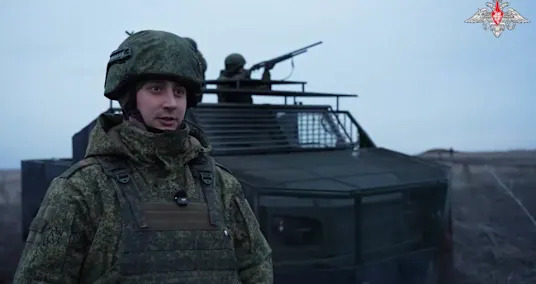
The Ukrainian battlefield is littered with destroyed Russian vehicles, with Ukraine reporting the destruction of over 120,000 Russian vehicles. While these figures are likely elevated, Oryxspioenkop still documents 18,400 visually confirmed losses. To offset these losses, Russia first drew from its stockpiles of Cold War-era military equipment before increasingly turning to commercial platforms, including motorcycles and pickups. This shift toward improvised and commercial systems has set the stage for new purpose-built designs. On March 25, 2026, the Russian Ministry of Defense announced on Telegram that it had begun large-scale fielding of the Ulan-2 light all-terrain tactical vehicle. While this vehicle is unlikely to significantly alter the battlefield, its deployment points to an emerging trend in Russian procurement, emphasizing the mass production of simple, purpose-built systems tailored to the demands of the current fight.
The Ulan-2 Light All-Terrain Tactical Vehicle
The Ulan-2 is a light all-terrain tactical vehicle, reportedly built on the GAZ Sobol 4×4 platform, retaining the core mechanical characteristics of a light commercial truck. It features all-wheel drive and a payload capacity of approximately 1.5 tons. According to the Telegram post, the vehicle is powered by a commercial engine producing 120 horsepower, consistent with Sobol variants, and can reach speeds of up to 120 km/h. It is designed for off-road mobility, incorporating increased ground clearance, a reinforced suspension system, and a locking differential that improves traction in rugged terrain.
Physically, the Ulan-2 resembles a stripped-down utility vehicle rather than a conventional military platform. It has a boxy, cab-forward layout with a short hood and a visibly simplified structure. In many observed configurations, the vehicle lacks full doors, reducing weight and simplifying construction, but leaving occupants exposed. The rear section is typically open or semi-open, often configured with a flatbed or basic frame that can accommodate personnel or cargo. The Telegram post also shows soldiers adding features to the Ulan-2 vehicles, including radio jammers, rubber mats, and nets to protect against drone attacks.

Image captured from video posted on social media by the Russian Ministry of Defense showing a Ulan-2 tactical vehicle being driven after it has been outfitted with tactical protective measures.
Social Media CaptureThe Ulan-2 was developed as part of a broader effort to adapt civilian automotive platforms for military use. Rather than emerging from a traditional defense procurement program, it appears to have been developed through a decentralized process involving Russian industry and military stakeholders working from existing commercial designs. By leveraging the GAZ Sobol platform, developers were able to modify a widely available vehicle rather than designing a new system from the ground up, reflecting a focus on rapid production and simplicity.
Development and fielding of the Ulan-2 occurred on a compressed timeline during the war. Initial references to the system emerged in 2023, with subsequent sightings and limited fielding through 2024 and into 2025. This suggests an iterative approach, with the vehicle likely refined based on battlefield feedback rather than following a fixed development program. The Russian Ministry of Defense formally announced the system’s broader deployment in March 2026.
Russia’s Need For The Ulan-2 On The Modern Battlefield
Unlike other vehicles in the Russian inventory, the Ulan-2 is designed to meet Russia’s current needs on the battlefield. In particular, the Russia–Ukraine battlefield is increasingly defined by kill-zones. These areas, often extending several kilometers in front of Ukrainian defensive lines, are under constant surveillance by drones and covered by pre-registered artillery fires. Any movement detected within these zones can be rapidly targeted, often within minutes. As drone capabilities have advanced, these kill-zones have expanded in depth, further complicating Russian efforts to maneuver and conduct assaults.
In response, Russia has adapted its tactics, moving away from assaults using large armored columns. Instead, it is increasingly relying on small, dispersed groups of soldiers, sometimes at the fireteam level, pushing forward into contested areas. These elements advance incrementally, establishing positions within or even beyond Ukrainian defensive lines. Given the depth of these kill-zones, advancing on foot is often impractical, as it requires prolonged exposure and increases the likelihood of detection. Russian forces have experimented with motorcycles, ATVs, and even horses, but with limited success.

Image captured from a video posted on social media by the Russian Ministry of Defense. The image shows the production facility for the Ulan-2 tactical vehicle.
Social Media CaptureThe Ulan-2 offers a more viable option for this type of movement. A single, compact vehicle can transport a small group of soldiers on one platform, reducing the overall signature compared to multiple smaller vehicles moving together. This helps balance the need for speed and mobility with the requirement to minimize detection. In some cases, Ulan-2 variants have also been fitted with counter-drone protection systems, improving the likelihood that assault elements can reach forward positions within these contested kill-zones. The vehicle’s open design, including its lack of doors, further allows for rapid egress, particularly in the event of an imminent drone strike.
Once these small units establish forward positions, sustaining them becomes a primary challenge, as they require continuous resupply of ammunition, food, water, and medical support. Larger military logistics vehicles are highly vulnerable in these environments, while smaller platforms such as ATVs and motorcycles lack the payload capacity and provide little protection. The Ulan-2 is also well suited to fill this capability gap, as it can carry meaningful loads while maintaining a relatively low signature and sufficient mobility to operate within drone-covered kill-zones.
Implications of the Ulan-2 on the War
The introduction of the Ulan-2 is unlikely to have a decisive impact on the war. At the platform level, it does not provide a qualitative advantage in firepower, protection, or survivability. Its primary contribution is incremental, improving the ability of Russian forces to push soldiers forward, move supplies, and evacuate casualties under increasingly contested conditions. However, the platform remains highly vulnerable, particularly to Ukrainian drones. While it may incorporate some counter-drone protection, these measures will be challenged by the rapid evolution of drone technology.

Image captured from a video posted on social media by the Russian Ministry of Defense. The video shows the development and fielding of the Ulan-2 tactical vehicle.
Social Media CaptureIts significance lies more in what it represents than in what it delivers tactically. The Ulan-2 reflects an emerging Russian willingness to adopt rapid, adaptive development pathways that rely on modifying commercial technologies for military use. This approach reduces development timelines, lowers costs, and allows for iterative refinement based on battlefield feedback. To date, this has been a relative strength of Ukrainian forces, which have demonstrated an ability to quickly field modified civilian systems ranging from drones to improvised ground vehicles. That adaptability has provided significant advantages, particularly in responding to new threats and exploiting emerging opportunities.
If Russia is able to institutionalize similar processes, the longer-term implications of the Ulan-2 could be more consequential. With a larger industrial base and access to mass production, Russia could scale such adaptations more broadly, narrowing Ukraine’s advantage in rapid innovation. In a protracted war of attrition, the ability to quickly develop, produce, and field large numbers of simple, purpose-built systems can be as important as traditional measures of military capability. As such, the Ulan-2 may represent much more than just a vehicle. Rather, it could signal a shift in how Russia approaches battlefield adaptation, with an increasing emphasis on speed, scale, and the rapid integration of commercially derived technologies.
LATEST POSTS
- 1
 Your kid wants it now. What saying yes, no or not yet teaches kids about money and instant gratification.
 - 2Which One Energizes You the Most These Tech Developments
- 3What Yogurt Types Do You Know
- 4L.A.'s most famous midcentury home, the Stahl House, is on the market for the 1st time, at $11K per square foot: See inside
- 5Lebanon says Israeli strike killed 13 people near Palestinian refugee camp



- Exploiting Unsold Rams: May Be Less expensive Than You Suspect
- 2024 Manual for Light Extravagance Room Feel: What's Moving
- Satellite data reveals a huge solar storm in 2024 shrank Earth's protective plasma shield
- The Delight of Perusing: Book Proposals for Each Class
- Australia Cracks Down on Gambling Ads as Prediction Markets Like Polymarket Remain Blocked
- New dietary guidelines recommend more dairy, meat and fats: What to know
- Israel Police arrest twenty-one as anti-war protests grow despite broad support for Iran war
- NASA is sending astronauts back to the moon. Can you see the Artemis 4 landing sites from Earth?
- Italian court approves extradition to Germany of Ukrainian suspect in Nord Stream pipeline blast